Onboard data logger: the heart of data for modern automotive engineering
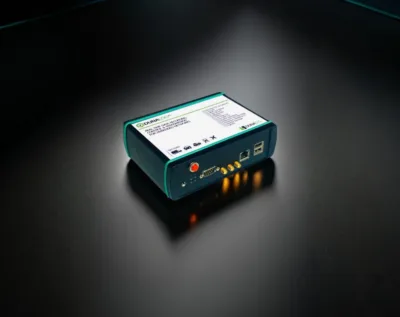
Embedded Datalogger: The Heart of Data for Modern Automotive Engineering
The global automotive industry is undergoing an unprecedented transformation. In this race for innovation — encompassing massive electrification, the rollout of ADAS systems, and the rise of the Software-Defined Vehicle (SDV) — mastering data has become the critical battleground. At the center of this ecosystem, the embedded datalogger is no longer a passive recorder. It is now the true beating heart of data acquisition: the indispensable tool that turns every kilometer driven into actionable intelligence for engineers.
What is an embedded datalogger in an automotive context?
An embedded datalogger, also known as a data recorder, is a self-contained computing unit designed to capture, timestamp with surgical precision, and store the streams of information flowing through a vehicle’s communication systems. Unlike a fixed laboratory acquisition unit, this device is optimized for extreme mobility and the most demanding field applications.
A Concentration of Robust Technology
To be integrated into a prototype, a system must meet very strict size and weight requirements so as not to interfere with the vehicle’s dynamic behavior. Robustness is paramount: a quality product must withstand constant vibrations, significant mechanical shocks, and an extremely wide temperature range.
Power management is equally critical for any modern recorder. The datalogger must be able to handle the fluctuating voltage of the onboard network and feature ultra-low-power standby modes to avoid draining the battery during extended monitoring phases. Every model in our range is engineered to deliver reliable performance regardless of shock or vibration conditions.
The Diversity of Connected Signals and Sensors
A modern logger acts as a central hub, consolidating heterogeneous sources:
- Vehicle bus protocols: It provides transparent reading of CAN, CAN FD, LIN, FlexRay, and automotive Ethernet networks.
- Analog and digital inputs: To connect pressure sensors, temperature sensors, or strain gauges, the system converts these signals into digital data via high-precision inputs.
- External and internal sensors: The integration of a GNSS receiver and an inertial measurement unit allows every measurement to be correlated with a geographic position.
Why Is the Datalogger Central to Modern Engineering?s
The Rise of ADAS and Autonomous Vehicles
Validating automated driving functions is the defining challenge of the decade. These systems rely on the fusion of data from multiple sensors. The sampling rates required to capture these streams are phenomenal. The datalogger is the sole guarantor of data integrity here. It enables the recording of edge-case scenarios on the road for later replay in the laboratory.
The Value Chain: From Sensor to AI
Automotive data engineering begins with high-quality acquisition. If data is poorly synchronized or if the communication protocol suffers frame loss, AI model training will be skewed. The datalogger ensures data is properly prepared:
- Capture: Receiving signals from various buses and sensors.
- Filtering: Selecting relevant messages to optimize internal memory usage.
- Storage: High-speed writing to a secure storage medium.
- Transmission: Uploading to the cloud for global analysis.
Predictive Maintenance and Fleet Monitoring
Grâce à un contrôle permanent des paramètres via le protocole de diagnostic, l’enregistreur devient un outil de surveillance préventive. En analysant les dérives de tension ou les pics de pression, les ingénieurs identifient une défaillance avant qu’elle ne survienne. Les loggers modernes permettent ainsi une surveillance à distance de différents types de véhicules simultanément.
The Technical Challenges of a High-Performance Acquisition System
Connectivity and Communication Protocols
Flexibility is the number-one asset. A good datalogger model must adapt to evolving architectures. The shift from a CAN system to a high-bandwidth Ethernet network demands scalable loggers. The ability to handle multiple protocol types without latency is what distinguishes a true measurement hub from a simple recorder.
Storage Capacity and Memory Management
As sampling rates increase, data volumes explode. Systems must integrate internal memory capable of sustaining massive throughput. Intelligent storage management is vital for long-duration tests where terabytes of data are recorded.
Synchronization and Timing Precision
In a multi-sensor application, even minor desynchronization can render measurements useless. Using loggers with a GPS-synchronized internal clock is imperative to ensure every sample is perfectly aligned.
From Datalogger to AI: Exploiting the Data
Simulation and Digital Twins
Raw data collected by recorders is used to feed digital twins. By injecting real-world measurements into simulation models, manufacturers can validate software without deploying physical vehicles. The output of this acquisition process becomes the foundation of the entire development cycle.
Toward the Software-Defined Vehicle (SDV)
Within the SDV framework, vehicle architecture is central. The datalogger interfaces directly with the vehicle’s core system for continuous monitoring. It enables an immediate response when an anomaly is detected on the network and facilitates data transmission back to management platforms.
How to Choose Your Embedded Datalogger
To select the right product, evaluate these essential criteria:
- Number of inputs: How many CAN buses and analog inputs are required?
- Sensor types: Compatibility with pressure, voltage, or temperature sensors.
- Sampling rate: What frequency do your measurements require?
- Size and weight: The system must integrate seamlessly.
- Environment: Resistance to shock and vibration, and power supply stability.
- Storage: Internal memory capacity and storage medium type.
Many models and types of recorders exist on the market, but DUNASYS’s expertise lies in selecting and integrating the ideal acquisition system for your specific application.
Conclusion
The embedded datalogger has become an indispensable measurement tool — the true heart of any automotive data strategy. By guaranteeing reliable data acquisition and high-precision sampling, it reduces costs and accelerates innovation. The quality of your recorder and storage architecture will determine the reliability of your future systems.
Contact the DUNASYS experts to discover our recorder models and optimize your measurement system today.
Questions & Answers
It is a self-contained acquisition system capable of recording data from networks and external sensors under real driving conditions.
This recorder connects to the network, listens to the frames of the protocol in use, timestamps them, and saves them to its internal memory.
Yes, by using the right protocol, the logger queries the control units to extract temperature, voltage, or pressure readings.
Absolutely. Synchronized data from the acquisition process makes it possible to validate systems using real, precise measurements.
Security relies on encryption at the storage level and the use of encrypted transfer systems to your data hub.
Yes, the loggers are designed for monitoring different vehicle models across entire test fleets.