Dunasys technology

Duanacan

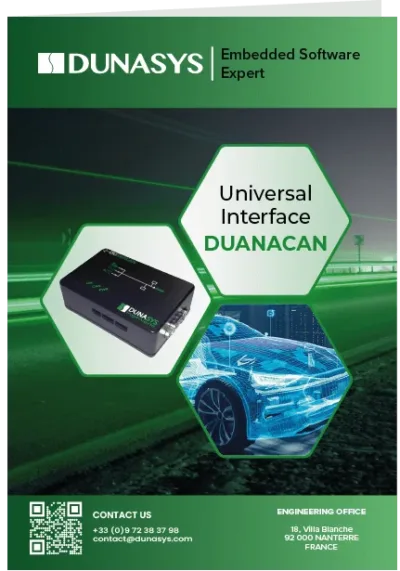
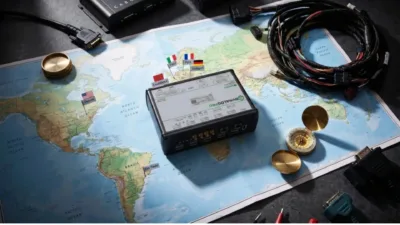
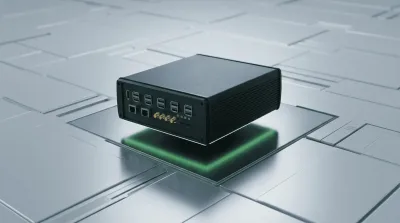
Duanacan is a universal interface designed to convert analog signals and LIN network data into CAN messages. Compact and easy to integrate, it simplifies vehicle instrumentation and enables the seamless addition of sensors to existing CAN-based architectures.

Design Sans Titre (28)

Why Choose DUANACAN?

Features
Specifications
Accessories
CAN Conversion

Duanacan converts analog, thermal, and LIN signals into usable CAN messages. It enables the rapid integration of new data sources into existing vehicle networks, without requiring major modifications to the architecture.

Multi-Sensor Data Acquisition

The device supports the simultaneous connection of multiple sensor types, including analog signals, thermocouples, and LIN networks.

This flexibility enables engineers to collect and centralize data from a wide range of sources within a single platform.

LIN-to-CAN Gateway

Duanacan acts as a gateway between LIN networks and CAN buses, centralizing data within a single architecture.

Thermal Monitoring

Thermocouple inputs enable temperature data to be measured and transmitted over CAN for engine and electronic testing applications.

Fast Integration

Thanks to its compact form factor and standard interfaces, the device can be easily integrated into a test vehicle or prototype.

Visual Status Indication
Activity LEDs provide a quick visual indication of the operating status and interface activity.
Broad Compatibility

Compatible with tools commonly used by engineering teams:

  • Vector CANalyzer / CANape
  • MATLAB / Simulink
  • CAN analysis tools
  • Other industry-standard engineering and validation software
Interfaces
  • 1 High-Speed CAN interface (CAN 2.0B)
  • 1 LIN interface (LIN 2.0 / 2.1)
  • 4 analog inputs (0-5 V)
  • 2 Type K thermocouple inputs
  • 1 power output, 5 V (500 mA max.)
Communication

CAN bitrate up to 500 kbit/s

Power Supply
  • Supply voltage: 6 to 30 V DC
  • Typical current consumption: 20 mA @ 12 V
Indicators

4 activity and status LEDs

Sensors

DUANACAN can be used with a wide range of sensors for vehicle instrumentation applications, including:

  • Analog sensors
  • Temperature sensors
  • Embedded LIN systems

Its compact form factor enables easy installation in test vehicles and test bench environments.

Multiple Use Cases

Vehicle Instrumentation

Connection of analog sensors and transmission of data over the CAN network.

Electronic Prototyping

Rapid integration of sensors during the development phases of a vehicle architecture.

Sensor Validation

Collection and analysis of physical data from installed sensors.

LIN Network Integration

Conversion of LIN data to CAN messages for centralized data management.

A Simple Interface for Connecting your Sensors to CAN

DUANACAN enables the easy integration of new sensors into existing CAN architectures. It converts analog, thermal, and LIN signals into CAN messages that can be directly processed by your analysis systems. A compact and efficient solution for testing, prototyping, and vehicle instrumentation applications.

Img Dunasys 26

Answers to Your Questions

A CAN (Controller Area Network) interface is an electronic communication module that connects, centralizes, and enables different equipment or sensors to communicate over a network. In the automotive and transport sectors, the CAN bus is the reference standard. The interface acts as a gateway for the reliable transmission and reception of data between control units and measurement tools, even in environments subject to strong electromagnetic interference.

The Duanacan device acts as a smart transmitter that collects signals of various kinds and translates them into standardized messages. It supports:

  • Data from analog sensors.
  • Thermal measurements.
  • Streams from a secondary LIN network.

This information is encapsulated as bytes within a standard CAN frame, making the physical values immediately usable by your acquisition systems.

The CAN protocol relies on synchronous communication. The Duanacan interface supports a bitrate (the bit transfer speed) of up to 500 kbit/s, ensuring excellent time synchronization of messages across the network. At the physical and protocol level, priority management and collision detection on the bus are handled through arbitration between the dominant and recessive states of the signal.

To simplify frame analysis and the processing of diagnostic code, our CAN interface offers full compatibility with the standards of the automotive engineering and development market:

  • Vector CANalyzer / CANape: for monitoring and data logging.
  • MATLAB / Simulink: for rapid prototyping and simulation.
  • All third-party bus monitoring tools that support the CANopen or J1939 protocols.

This compact module integrates seamlessly into development applications on test vehicles or test benches:

  • Vehicle instrumentation: quickly add temperature or pressure sensors without changing the original architecture.
  • Electronic prototyping: integrate new functions before industrialization.
  • Validation and measurement: collect physical data synchronized with the main bus messages.

Designed to be embedded, the device offers specifications suited to the constraints of onboard networks:

  • Wide-range power supply: from 6 to 30 V DC (ideal for 12 V and 24 V systems).
  • Low power consumption: only 20 mA @ 12 V in standard mode.
  • Ports and connectivity: 1 high-speed CAN port, 1 LIN interface, 4 analog inputs, 2 thermocouple inputs, and 4 LEDs to indicate activity and the status of the receive buffer.
  • Optimized format: minimal weight and dimensions for easy installation in confined areas of a vehicle.

The CAN protocol natively includes very strict hardware safety mechanisms. The Duanacan interface ensures that every frame sent strictly complies with these communication rules. In the event of line disturbances, the receiver or transmitter can detect the anomaly instantly to isolate the fault, ensuring the continuity of the acquisition of your critical measurement data.

Our Documentation

Access Our Complete Library of Technical Datasheets.

Plaquette Site Duanacan
Img Dunasys 9

Need to Quickly Integrate Sensors or a LIN Network into Your CAN Architecture?

Learn more

A Compact CAN Interface for Vehicle Instrumentation

Duanacan is a compact CAN interface designed to convert analog, thermal, or LIN signals into usable CAN messages. It makes it possible to quickly add new data sources to an existing vehicle architecture, without major changes to the onboard network.

Designed for test, validation, and engineering teams, Duanacan simplifies vehicle instrumentation by connecting different types of sensors to a CAN network. With its analog inputs, thermocouple inputs, and LIN interface, it can collect additional information from a test vehicle, a prototype, or a test bench.

Used as a LIN to CAN gateway, Duanacan centralizes data from sensors and embedded subsystems to make it accessible within a standard CAN environment. This capability simplifies data acquisition, monitoring, and analysis during automotive test campaigns.

Compact, easy to integrate, and compatible with the tools commonly used by engineering teams, Duanacan is an effective solution for enriching an existing CAN architecture, accelerating sensor integration, and improving the reliability of vehicle data reporting.

window.axeptioSettings = { clientId: "6a0ef5d9520c669d99b0637f", cookiesVersion: "19g69mq6ef0um", }; (function(d, s) { var t = d.getElementsByTagName(s)[0], e = d.createElement(s); e.async = true; e.src = "//static.axept.io/sdk.js"; t.parentNode.insertBefore(e, t); })(document, "script");