Battery Internal Resistance: A Key Indicator of Aging
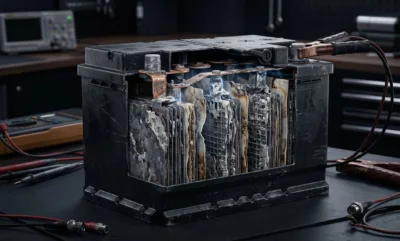
Battery Internal Resistance: A Key Indicator of Aging
In the ecosystem of the modern vehicle, whether electric, hybrid, or combustion, the battery is a complex system whose health cannot be reduced to its simple resting voltage. For automotive electronics experts and fleet managers, one technical parameter stands out as the ultimate judge: internal resistance. This indicator is a direct reflection of battery aging and its ability to deliver a sufficient quantity of electricity at the right moment.
While capacity measures the total volume of stored energy, the battery’s internal resistance determines the efficiency with which that energy flows through the circuit. Low resistance is a sign of a fully healthy battery capable of maintaining high-level performance, while a high value indicates imminent end of life. For a manufacturer or fleet manager, ignoring this impact means ignoring the very safety of the vehicle.
What Is the Internal Resistance of a Car Battery?
Internal resistance can be visualized as a friction force within the storage system. During discharge, current encounters physical opposition as it passes through the cell components. This phenomenon causes an immediate voltage drop at the terminals, reducing the vehicle’s overall energy efficiency and limiting the maximum available power.
From a structural standpoint, this resistance divides into two major categories:
- Ohmic resistance: This depends on the quality of the conductive materials. It includes the resistance of the lead or lithium plates, collectors, wire solder joints, and even the oxidation of electrical connectors.
- Ionic resistance: This is related to the mobility of ions within the electrolyte. The more degraded the electrolyte, the more impeded the ionic flow becomes, increasing the resistance measured during a technical analysis.
Internal resistance increases as a battery ages or sulfates. High resistance limits current flow precisely when the battery needs it most: during starting.
Why Does Internal Resistance Increase Over Time?
Aging is an inevitable process influenced by several physicochemical factors. Understanding why this value rises enables better management of battery lifespan.
-
Sulfation and acid: In a classic starter battery operating on sulfuric acid, sulfate crystals form on the plates. If the battery is discharged too frequently, these crystals harden, creating an insulating barrier that causes resistance to spike at the heart of the circuit.
-
Lithium-ion degradation: In an electric vehicle, the repeated movement of lithium ions during cycles eventually creates micro-cracks in the electrodes. A passivation layer forms, slowing the flow of electrical energy and impacting overall performance.
-
The impact of temperature: Temperature is a critical factor. Extreme cold increases electrolyte viscosity, raising resistance. Conversely, excessive heat accelerates internal corrosion, prematurely degrading the characteristics defined by the manufacturer.
-
Material wear: Physical erosion of the plates reduces the exchange surface area, increasing the difficulty for current to flow smoothly.
A sudden increase in resistance, even if the battery still passes the test, can signal an imminent failure.
How to Measure Battery Internal Resistance
Battery diagnostics require dynamic measurement. It is not enough to check the voltage; you must observe how the battery responds under load to assess its true state of health. According to EN 50342-1 and IEC 60095-1, measurement must be carried out at a stabilized temperature and at a defined state of charge, as both factors directly influence the value obtained. It must therefore be interpreted alongside other metrics.
The Conductance Battery Tester
The conductance battery tester is the preferred tool in maintenance workshops. It injects an alternating signal to assess the battery’s ability to conduct current through its system. It is a fast method that provides a precise picture of plate performance without draining the vehicle’s energy.
Current/Voltage Pulse Analysis
This is the reference method for maximum precision. A very brief current/voltage pulse is applied and the induced voltage variation is measured. This ratio precisely defines the internal resistance at a given moment. This technique is at the heart of modern energy management.
Why Is It the Most Reliable Indicator for Your Fleet?
Unlike capacity, which can appear stable for a long time, internal resistance is a predictive indicator of aging.
- Safety and risk: High resistance generates excessive heat through the Joule effect. In a high-voltage battery pack, this increases the risk of fire or thermal degradation.
- Starting reliability: For a combustion vehicle, internal resistance determines whether the battery can deliver the hundreds of amperes required by the starter motor despite cycle wear.
- Electronic health: A stable battery protects onboard electronics against voltage spikes and sudden drops that could damage sensitive components.
A healthy battery produces consistent results across several consecutive tests. If a battery passes the test once but fails under slightly different conditions, the investigation must go further. On a continuously embedded telematics unit, this inconsistency translates into unusual variability in resting voltage or starting current measurements between cycles, a detectable signal well before any failure occurs.
Telematics Measurement: The DUNASYS Innovation
For fleet management optimization, immobilizing vehicles for manual tests is a significant constraint. DUNASYS has developed a solution that automates this function remotely through continuous telematics analysis.
The DUNASYS Unit: An Onboard Brain
The DUNASYS unit extracts internal resistance during current transients at startup (starter pulse followed by return to equilibrium). This measurement, repeated at every start cycle, constitutes a particularly reliable early aging indicator over the long term.
Scientific Analysis of Characteristics
On a continuously embedded telematics unit, inconsistent results do not go unnoticed. Unusual variability between two consecutive start cycles, whether an unstable resting voltage or an erratic current peak, is automatically detected and logged. Where a workshop tester requires multiple passes to confirm a suspicion, the unit flags it from the very first signs, without any human intervention.
The Benefits of Predictive Maintenance
By tracking the impact of charge cycles on internal resistance, DUNASYS enables:
- Scheduling battery replacement before an immobilizing failure occurs.
- Reducing maintenance costs by avoiding emergency interventions on a discharged battery.
- Guaranteeing driver safety through constant monitoring of the condition of ion-lithium or lead-acid accumulators.
Conclusion: A Performance Lever for the Energy Future
Mastering battery internal resistance has become indispensable for any sustainable mobility strategy. It is the indicator that enables the transition from reactive maintenance to proactive management of onboard electricity. By monitoring the evolution of resistance over time, the longevity of the storage system is assured.
Thanks to DUNASYS measurement and analysis solutions, the car battery is no longer a black box. It becomes a transparent component whose efficiency, safety, and lifespan are maximized, ensuring optimal performance across the entire product lifecycle. Whether for lithium or acid batteries, resistance monitoring is the key to modern energy efficiency.