Predictive Battery Maintenance: Anticipating Failures in Fleets
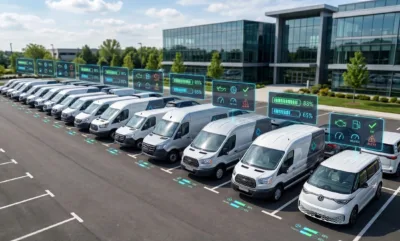
Predictive Battery Maintenance
In the ecosystem of modern mobility, the battery has become the most strategic component. Whether in urban logistics or long-distance transport, the performance of a vehicle now depends on the health of its energy pack. However, fleet management cannot be improvised: an unexpected failure leads to an immediate halt in activity, generating high assistance costs and disruption to logistics networks.
To mitigate these risks, predictive battery maintenance has established itself as the reference solution. Unlike conventional methods, it relies on the systematic analysis of data collected in real time, making it possible to transform raw data into a performance driver. At DUNASYS, we integrate cutting-edge engineering and IoT technologies to offer total surveillance of your assets.
Why Traditional Battery Tests Are Insufficient
For decades, fleet management has relied on preventive maintenance. This method consists of replacing parts or carrying out checks according to a fixed schedule or mileage. However, the actual condition of a lithium battery does not always follow a linear curve; its wear depends on the intensity of use and external factors such as operating pressure and temperature. A system based solely on a history of physical tests is incapable of detecting the weak signals of an imminent failure.
From Test History to Trend: From Snapshot to Trajectory
A single test is a snapshot. A series of results tells a story. Batteries do not fail instantaneously: they degrade progressively. Tracking results from one test to the next makes it possible to detect trends before failure occurs.
Concrete example: a battery losing 10% of its CCA between two service intervals may not fail today. But it is on that trajectory. This is an opportunity for proactive maintenance, not only to replace a battery, but to build customer confidence.
Whether you are a workshop manager, fleet manager, or owner of a single vehicle, the question is no longer whether your battery will fail, but when. A one-off test cannot answer this question. Only continuous onboard monitoring can, by transforming invisible data into an anticipated decision.
The Risk of Critical Failure
The inadequacy of instantaneous tests inevitably leads to failure. When a breakdown occurs in the middle of a mission, the consequences are critical: call-out of a breakdown vehicle, delays, and prolonged immobilization of the machine. Reactive maintenance is the most costly scenario for any business whose project relies on mobility. Without an advanced analysis solution, the risk of unexpected stoppage directly threatens the profitability of your assets.
From One-Off Testing to Continuous Monitoring
The revolution of predictive maintenance lies in the transition from episodic checks to permanent battery monitoring. Through the installation of smart sensors on the vehicle’s onboard network, every operating parameter is transmitted instantaneously. This digitization step makes it possible to track wear in real time and shift toward a proactive strategy where data guides every intervention.
Workshop testing has its structural limitations: it is episodic, carried out under controlled conditions, and does not capture the battery’s actual behavior during daily use. Yet it is precisely during this use that the most significant degradation mechanisms occur:
- Cold starts at -15°C that push the battery to its maximum limits.
- Repeated DC fast charges that induce thermal and electrochemical stress.
- Extended parking periods with active parasitic consumers.
- Intensive regenerative braking cycles that overload cells at the lower temperature limit.
How Battery Monitoring Works: Key Parameters
For a predictive maintenance algorithm to be effective, it must rely on precise physical variables. However, none of these situations are visible in the workshop. They occur on the road, at night, in extreme cold, where no tester will ever be connected. It is precisely to fill this blind spot that the DUNASYS telematics unit continuously measures the battery’s real parameters under actual operating conditions.
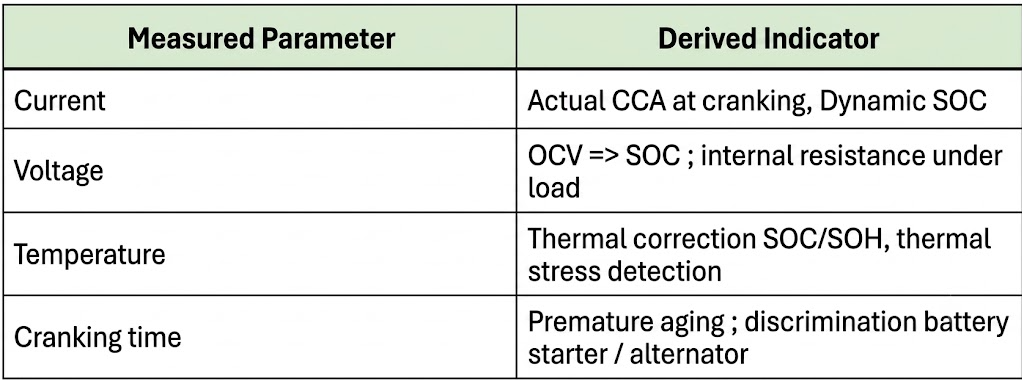
The unit analyzes every start, charge, and rest cycle in real time. The data is transmitted to the DUNASYS cloud platform, where SOH and RUL (Remaining Useful Life) predictions are continuously refined. The more cycles the unit accumulates, the more precise its estimates become.
Concrete Failure Detection Case: Degradation Over 24 Months
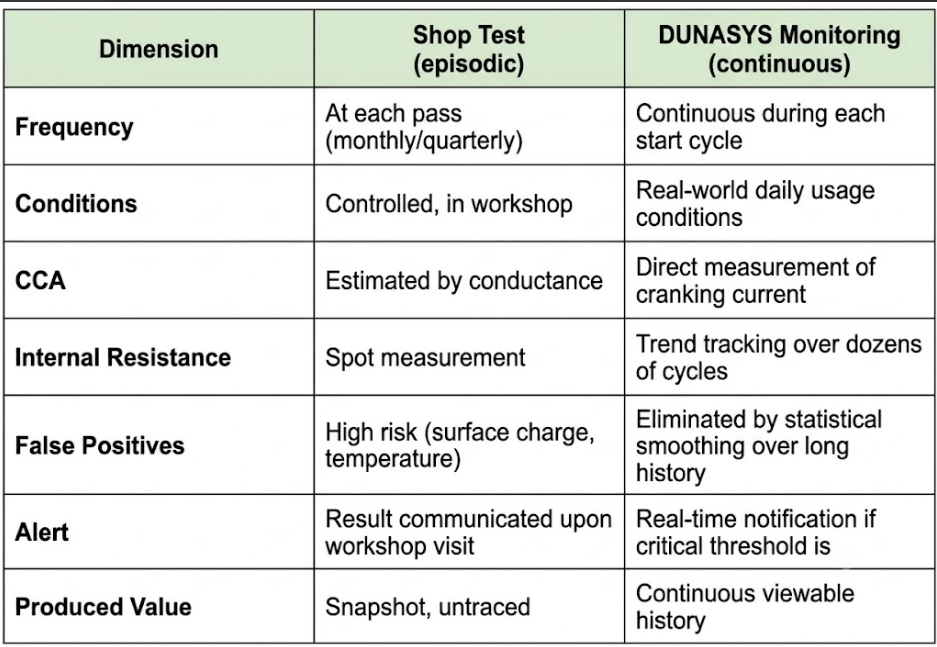
The table above compares two approaches on paper. The following figure confronts them with a real case: the same battery, monitored over 24 months, as seen by a workshop tester and by continuous monitoring. The gap speaks for itself.
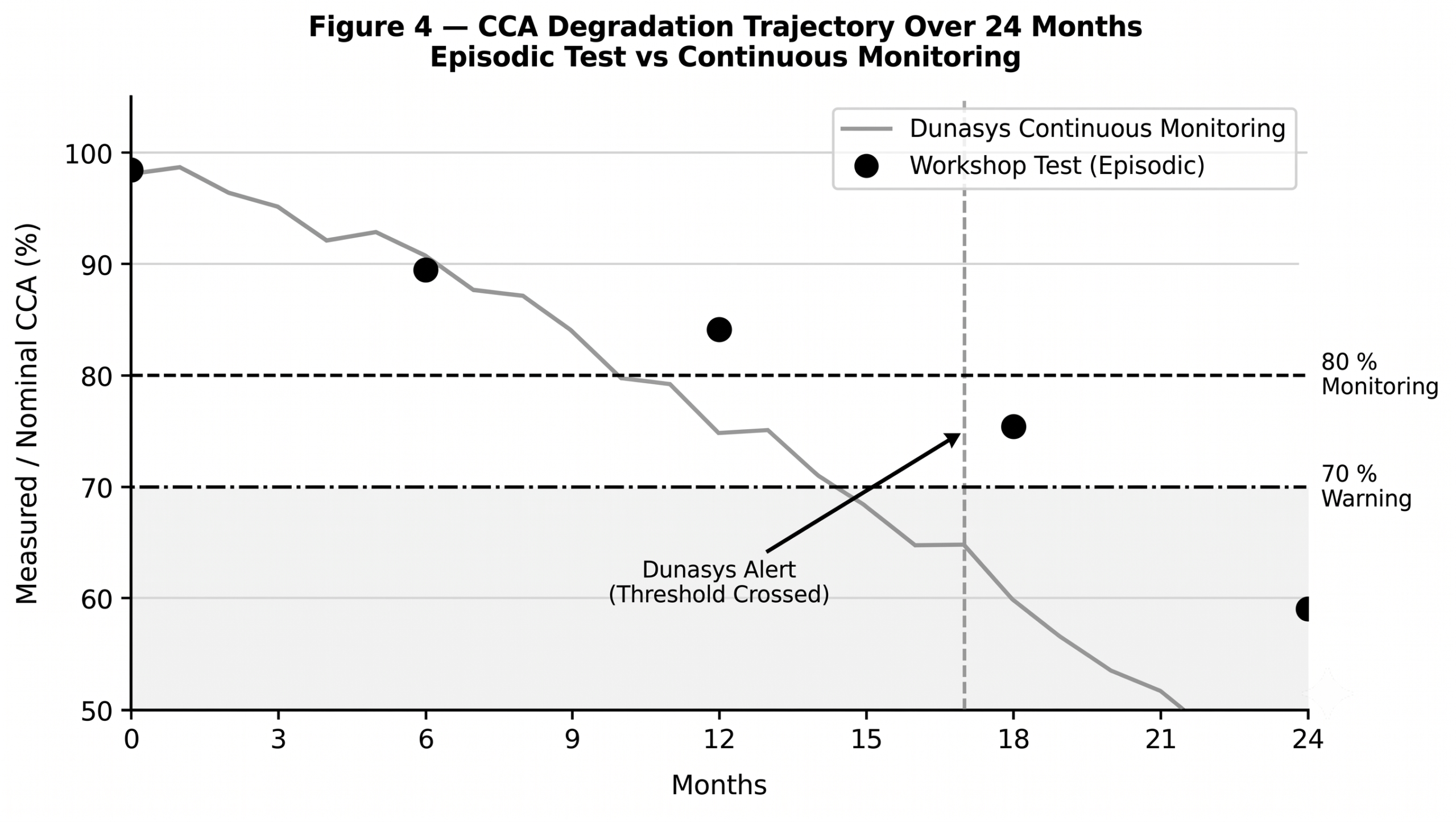
The workshop tester detects the problem at month 18, during the next scheduled visit. The DUNASYS unit had flagged it at month 17, before the critical threshold was crossed, before the failure, before the vehicle was left immobilized.
Why Predictive Maintenance Is Strategic for Fleets
Integrating this technology into your asset management is not merely a technical improvement; it is a strategic decision that directly impacts the profitability and sustainability of your project. It enables the transition from reactive management to total control over the lifecycle of your equipment.
Optimizing Operational and Maintenance Costs
Reactive maintenance costs up to 10 times more than planned maintenance. By avoiding critical failures, you reduce assistance and towing costs. In addition, precise knowledge of battery condition enables better negotiation of insurance contracts and optimization of spare parts inventory. Monitoring solutions make it possible to replace only the failing components rather than all components, thereby reducing resource waste and unnecessary costs.
Network and Machine Safety
An overheating battery represents a major fire risk. Permanent monitoring through our tools guarantees that every machine and every vehicle operates safely, protecting both employees and network infrastructure. Real-time analysis of collected data prevents any thermal or electrical failure before it becomes dangerous, securing all of your transport networks.
DUNASYS Expertise: Tailored Solutions for Your Projects
At Dunasys, we do not simply provide tools; we build a comprehensive maintenance project alongside you. Our services include sensor installation, IoT communication network setup, and the provision of simplified analysis interfaces for your decision-makers.
Battery health does not depend on luck or intuition. It depends on data, and on the ability to interpret it at the right moment, not after the failure, but well before it occurs.
A healthy battery delivers stable voltage, sufficient starting power, low internal resistance, and predictable performance. But these characteristics evolve silently, cycle after cycle, degree by degree. It is this evolution that one-off testing cannot capture.
Whether you are a technician, workshop manager, fleet manager, or vehicle owner, the question is the same: do you want to discover the failure when it happens, or anticipate it while it is still developing? The DUNASYS telematics unit provides a concrete answer: where a one-off test takes a photograph, the unit films. Degradation becomes visible, traceable, and above all, avoidable.
Would you like to assess the health of your battery or your fleet? DUNASYS supports fleet managers and mobility operators in implementing a predictive maintenance solution tailored to their needs.