Connected Insole – Operator Safety in Industrial and Construction Environments
An invisible technology, designed to protect those who need it most.
Context & Challenges
In industrial and construction sectors, every working day exposes operators to multiple risks: falls, heavy lifting, hazardous areas, and movement through confined spaces. While protective equipment plays an essential role, safety also depends on the ability to anticipate critical situations and ensure continuous traceability of risk-related behaviors.
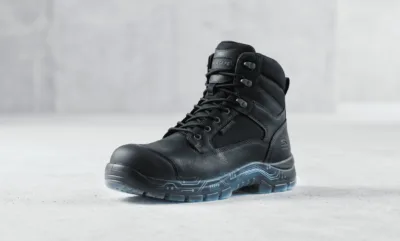
To address these challenges, a major industry player set out to develop a connected insole fully integrated into safety footwear. The objective was to create a self-contained device capable of detecting anomalies, alerting the operator, and interacting with its environment without compromising comfort or altering daily habits. This ambition came with an additional challenge: achieving an exceptional two-year battery life without recharging, while keeping the electronics completely invisible.
Project Challenges
From the earliest stages, several major constraints emerged. The project required the miniaturization of a complete electronic board within an extremely limited space, while ensuring mechanical robustness capable of withstanding impacts, vibrations, and the repeated flexing generated by every step. Power consumption had to be optimized to the highest level in order to achieve the targeted autonomy without compromising sensor accuracy.
At the same time, the system needed to reliably detect abnormal movements, enable new interactions such as opening doors through a simple foot tap, integrate a vibration-based alert mechanism, and provide low-power geolocation capabilities. Finally, the entire solution had to remain invisible to the end user, seamlessly blending into the equipment without interfering with everyday movements. Achieving this balance between ergonomics, durability, and technology represented a significant engineering challenge.
Our Contribution
Dunasys designed a custom electronic board specifically engineered to be integrated directly inside the insole. This embedded intelligence detects abnormal movements such as falls, twists, or excessive load carrying, while immediately alerting the operator through an internal vibration system. The device also enables interaction with the surrounding environment, including automatic door opening through a simple foot tap, streamlining movement in controlled-access areas.
The solution also incorporates an ultra-low-power GPS tracking mechanism, activated only when necessary to preserve battery life. Every feature was designed around real-world use cases observed in the field, guided by a simple principle: retain only what genuinely improves operator safety and daily operations without introducing unnecessary complexity.
Precision Engineering
Achieving a two-year battery life required meticulous engineering work. Dunasys teams optimized every milliamp consumed, developed intelligent sleep strategies, selected highly efficient sensors, and redesigned the device’s entire power architecture. Numerous testing cycles were conducted under extreme conditions to ensure that the insole could withstand the daily constraints of real-world environments.
This project brought together the full range of Dunasys expertise: embedded electronics, hardware design, low-power firmware development, communications, and validation. The result is a true technological masterpiece, carefully concealed within the thickness of a simple insole.
Results & Added Value
The resulting solution is an invisible yet essential innovation. Perfectly integrated and non-intrusive, the insole becomes a permanent safety device that operators eventually forget they are wearing, even though it continuously protects them. The ambitious target of two years of battery life was successfully achieved through highly optimized power management, enabling long-term operation without maintenance intervention.
Its ability to detect anomalies at an early stage gives the system a proactive role in accident prevention, allowing action to be taken before incidents occur. The technology also opens up new possibilities in areas such as traceability, access control, prevention, and predictive maintenance, all directly integrated into equipment worn by workers.
Conclusion
This project perfectly illustrates the Dunasys philosophy: designing discreet, robust, and intelligent embedded technologies capable of transforming everyday equipment into genuine safety systems. The connected insole demonstrates that the most effective innovation is not always visible. Sometimes, it is quite literally beneath the feet of those it protects.