Digital Twin in the Automotive Industry: How Manufacturers Are Optimizing Their Tests
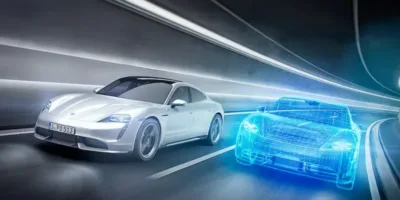
The automotive industry is in the midst of a profound transformation. Faced with the challenges of the energy transition, autonomous vehicles, and accelerating development timelines, manufacturers can no longer rely on traditional design and testing methods. At the heart of this transformation lies the digital twin, a technology that is redefining the way cars are imagined, built, and maintained. The digital twin is the key to virtual simulation that is faster, less costly, and dramatically more precise.
What Is a Digital Twin Applied to the Automotive Industry?
The automotive digital twin is an ultra-precise virtual replica of a real-world physical object, process, or system, such as a vehicle model, an engine, an assembly line, or even an entire factory.
This digital model is dynamic: it is not a simple static 3D mock-up, but a model equipped with algorithms and physical laws capable of simulating real-world behavior. It integrates data from its physical counterpart in real time or on a deferred basis, enabling engineers to visualize, analyze, and predict its operation. Initially created by digitizing existing vehicles, the digital twin now precedes the manufacture of the physical version, becoming the starting point of the design process.
Why Are Manufacturers Adopting the Digital Twin en Masse?
The widespread adoption of the digital twin is driven by the need to innovate faster while keeping costs and quality under control. The benefits for R&D and project delivery are spectacular.
Reduction in Physical Prototypes
Before the digital twin era, every design iteration required the manufacture of costly, time-consuming prototype parts and vehicles. With the virtual model, manufacturers can test thousands of variants (materials, structure, electronics) without touching the physical world. Renault Group, for example, uses this approach to virtually validate the architecture of its future vehicles.
Accelerated Virtual Testing
Embedded simulation makes it possible to drastically accelerate the testing phase. Where physical tests take weeks, virtual tests run in a matter of hours or even minutes. This applies to aerodynamics, engine performance, cooling systems, and above all the validation of ADAS and autonomous driving features. BMW validates the thermal flows of its electric batteries and its ADAS systems without mobilizing a single test bench.
Validation Under Extreme Conditions
Recreating extreme real-world conditions for testing is difficult, costly, and sometimes dangerous. The digital twin makes it possible to safely simulate crash-test scenarios, extreme temperatures, or complex road situations involving thousands of other vehicles (the environment twin), delivering comprehensive virtual automotive validation. PSA Peugeot Citroën is one example of a manufacturer that has historically leveraged simulation for boundary condition testing.
Types of Digital Twins in Automotive Engineering
The term digital twin does not refer to a single object, but to a series of virtual models applied at different levels of the automotive ecosystem.
Embedded System Twin
These twins focus on specific vehicle systems: the engine, the transmission, the ECU (Electronic Control Unit), or the full suite of ADAS software. They are essential for simulating the virtual behavior of electronic and mechanical components in interaction. This is the very essence of systems engineering as applied in the design office.
Full Vehicle Twin
This is the aggregation of all system twins to create a complete replica of the vehicle. This model enables analysis of global interactions, for example the impact of aerodynamics on energy consumption, or the dynamic behavior of the car during complex maneuvers.
Environment and Production Twin
This type of digital twin models the vehicle’s environment (road traffic, weather, infrastructure, crucial for autonomous development) or the manufacturing and supply chain process. Mercedes-Benz, in partnership with Siemens, created an energy twin to optimize its factory’s consumption toward 100% renewable energy. Optimizing the production chain represents a major gain for the business.
The Role of Embedded Data in the Digital Twin
The heart of the digital twin is its constant connection to the real world. It operates as a feedback loop: the virtual model predicts, reality verifies, and then enriches the model.
This connection is maintained through data collected via telematics, dataloggers, the CAN bus (Controller Area Network), and the many sensors with which vehicles are now equipped.
- During physical testing: measured data refines the calibration of the virtual model, ensuring that the simulation is a perfect mirror of physical reality.
- After manufacturing (throughout the vehicle’s lifetime): data transmitted from the cloud by customer vehicles is used for predictive maintenance. The digital twin of each vehicle in circulation is updated, enabling manufacturers to remotely diagnose issues, anticipate component failures, and improve future designs. It is a constant source of innovation.
How to Create a High-Performance Digital Twin
Creating a robust digital twin is a structured process requiring specialized tools and multidisciplinary collaboration.
- Initial modeling: Using CAD (Computer-Aided Design) and simulation tools to build the virtual structure of the car, its mechanical systems, and its software.
- Data collection and sensors: Defining the data to be collected (telematics, ADAS sensors, etc.) and setting up a cloud infrastructure for the large-scale ingestion of real-world data.
- Model calibration: The first physical data is used to calibrate the virtual model and guarantee its fidelity to real-world behavior. This step is crucial for the simulation to be usable.
- Virtual testing and validation: The digital twin is subjected to thousands of automated test scenarios. This is the stage where virtual testing and validation solutions replace physical trials.
- Deployment and twin lifecycle: The model continues to be fed by real-world data throughout the vehicle’s lifetime, supporting maintenance and the continuous development of software.
The digital twin is not merely a simulation tool, it is a data-driven development philosophy that enables automotive manufacturers to meet the challenges of tomorrow. By reducing costs and lead times while guaranteeing superior quality, it is undeniably the future of automotive design and manufacturing.
DUNASYS: Your Partner for Unlocking the Power of the Automotive Digital Twin
Adopting the digital twin in automotive requires powerful tools and deep expertise in systems engineering and data management. For manufacturers and parts suppliers, turning this promising technology into concrete business gains and ROI is the defining challenge.
At DUNASYS, we are at the heart of this innovation. We provide the digital testing and validation solutions that enable our clients to move from virtual design to successful manufacturing.
Questions & Answers
It is an ultra-precise virtual replica of a vehicle, a system, or a manufacturing process. It is fed in real time by data to simulate and predict the behavior of its physical counterpart.
The main advantages are a significant reduction in development costs and timelines (up to two years saved on physical testing), an improvement in vehicle quality and durability, and the ability to safely validate complex ADAS systems through virtual simulation.
It is created through digital modeling (CAD), then calibrated and enriched by real-world data collected by the sensors and telematics of physical vehicles. This model becomes dynamic and uses sophisticated algorithms to reflect the real world.
Virtual tests eliminate the need to build multiple costly and time-consuming physical prototypes. Engineers can iterate and validate thousands of design and software modifications directly within the virtual model, thereby reducing expenditure on materials, labor, and track testing time.