CCA Battery: Understanding the Cold Cranking Amps of a Car Battery

Starting a vehicle, especially in winter, relies on a crucial indicator that is often overlooked by drivers but essential for fleet managers: the CCA. Whether you are using a traditional lead-acid battery or a more advanced technology, understanding this value is the key to guaranteeing the longevity of your power supply and protecting your equipment.
What Is the CCA of a Battery?
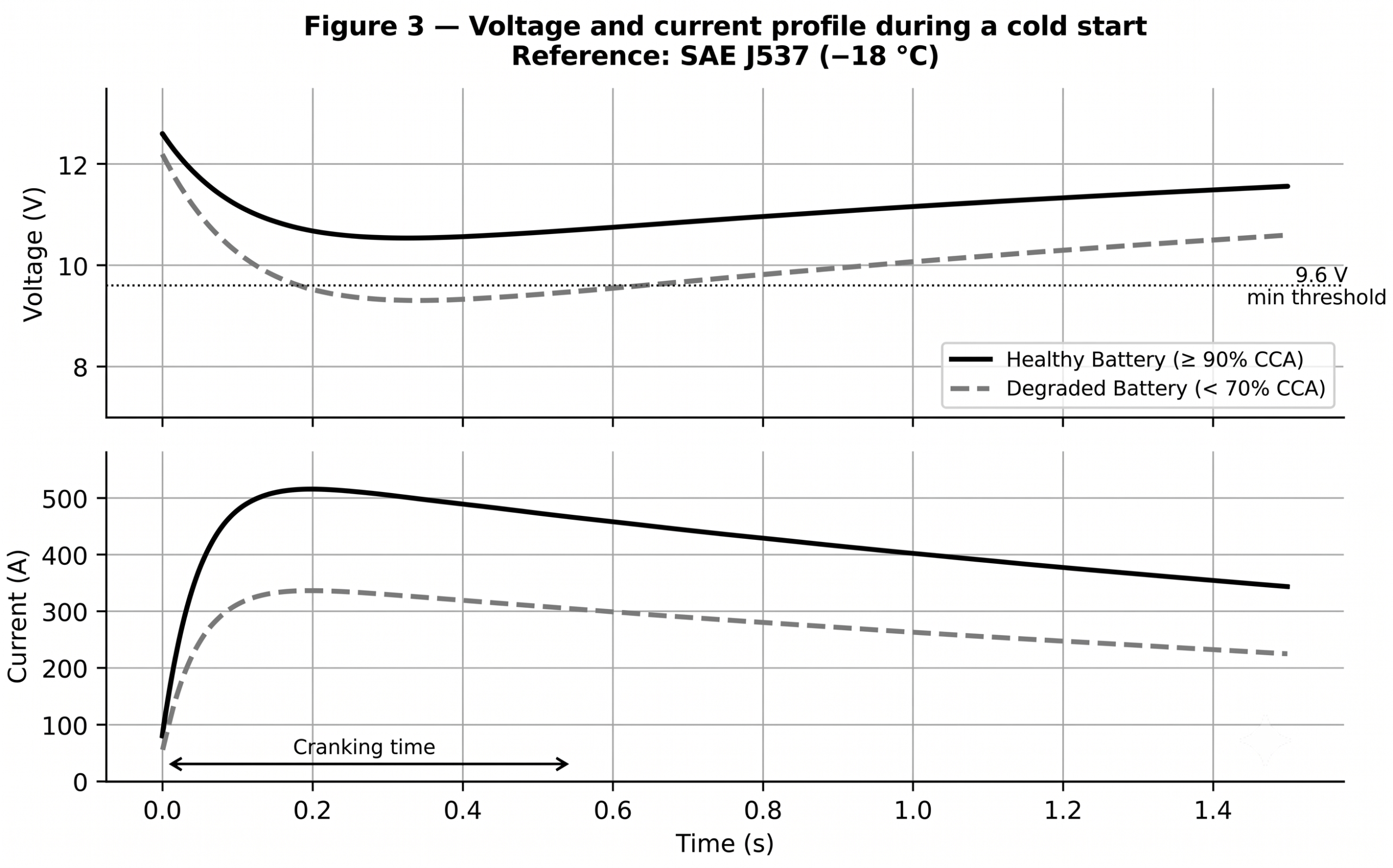
The acronym CCA stands for Cold Cranking Amps. It represents the maximum current a battery can deliver for 30 seconds at a temperature of -18°C while maintaining a minimum voltage sufficient to turn the engine over. Conductance testers estimate the battery’s Cold Cranking Amps by measuring its conductance, meaning its ability to deliver a high current in a short period of time.
Definition and Role
Unlike nominal capacity (expressed in Ah), which measures the total energy stored, CCA measures the raw power available instantaneously. It is the burst of energy needed to overcome the inertia of a cold engine and the viscosity of oil thickened by freezing temperatures.
Measured CCA vs. Nominal CCA
It is essential to distinguish between two values:
- Nominal CCA: This is the theoretical value printed on the product label by the manufacturer. It defines the battery’s original specifications.
- Measured CCA: This is the actual current the battery is capable of delivering at a given moment, as measured during a test. With use and time, the measured CCA inevitably diverges from the nominal value.
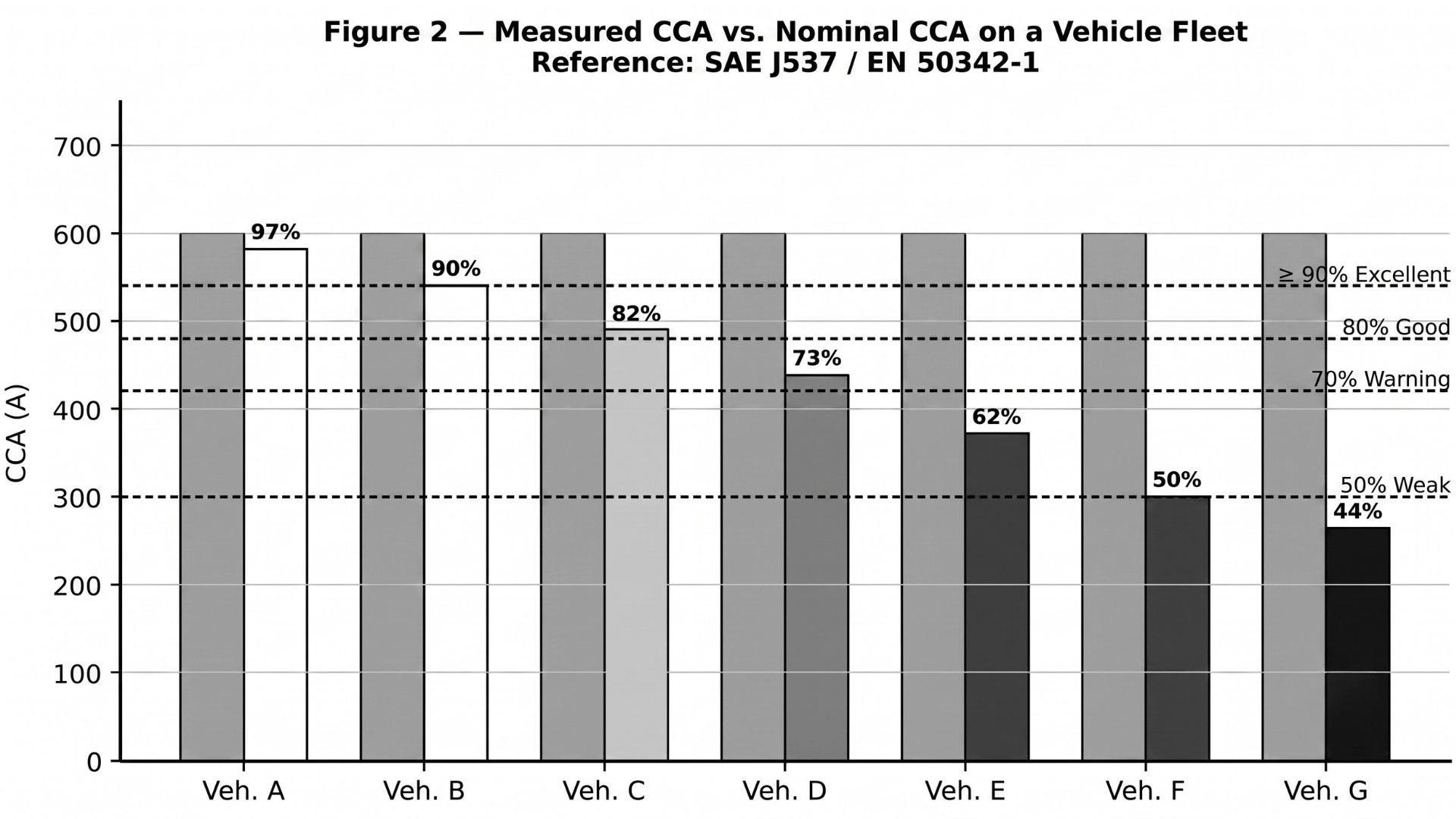
After the battery conductance test, the measured CCA is compared against the nominal CCA indicated by the manufacturer, a value established according to the conditions defined by the reference industry standards: SAE J537 (-18°C, North American standard) and EN 50342 (European standard).
Both standards set precise conditions for temperature, discharge duration, and minimum acceptable voltage at the end of the test. Comparing a measured CCA to a nominal CCA only makes sense if the tester and the manufacturer are working from the same reference, a point that is often overlooked in workshop environments.
How Does the CCA Test Work?
The CCA measurement test simulates an extreme discharge. In a laboratory setting, the battery is placed in a cold chamber at -18°C. A constant current equal to the stated CCA is then applied. To pass the test, the battery must not drop below a voltage of 7.2 volts in accordance with specific standards:
- SAE J537: The reference American standard.
- EN 50342: The European standard applied to vehicles in circulation across Europe.
For professionals, the use of an electronic tester makes it possible to estimate this value without fully charging or discharging the battery, thereby preserving the lifespan of the equipment. Whether for an AGM, liquid acid, or Lithium (LiFePO4) battery, the protocol guarantees that the vehicle can start safely.
How to Interpret a CCA Test Result
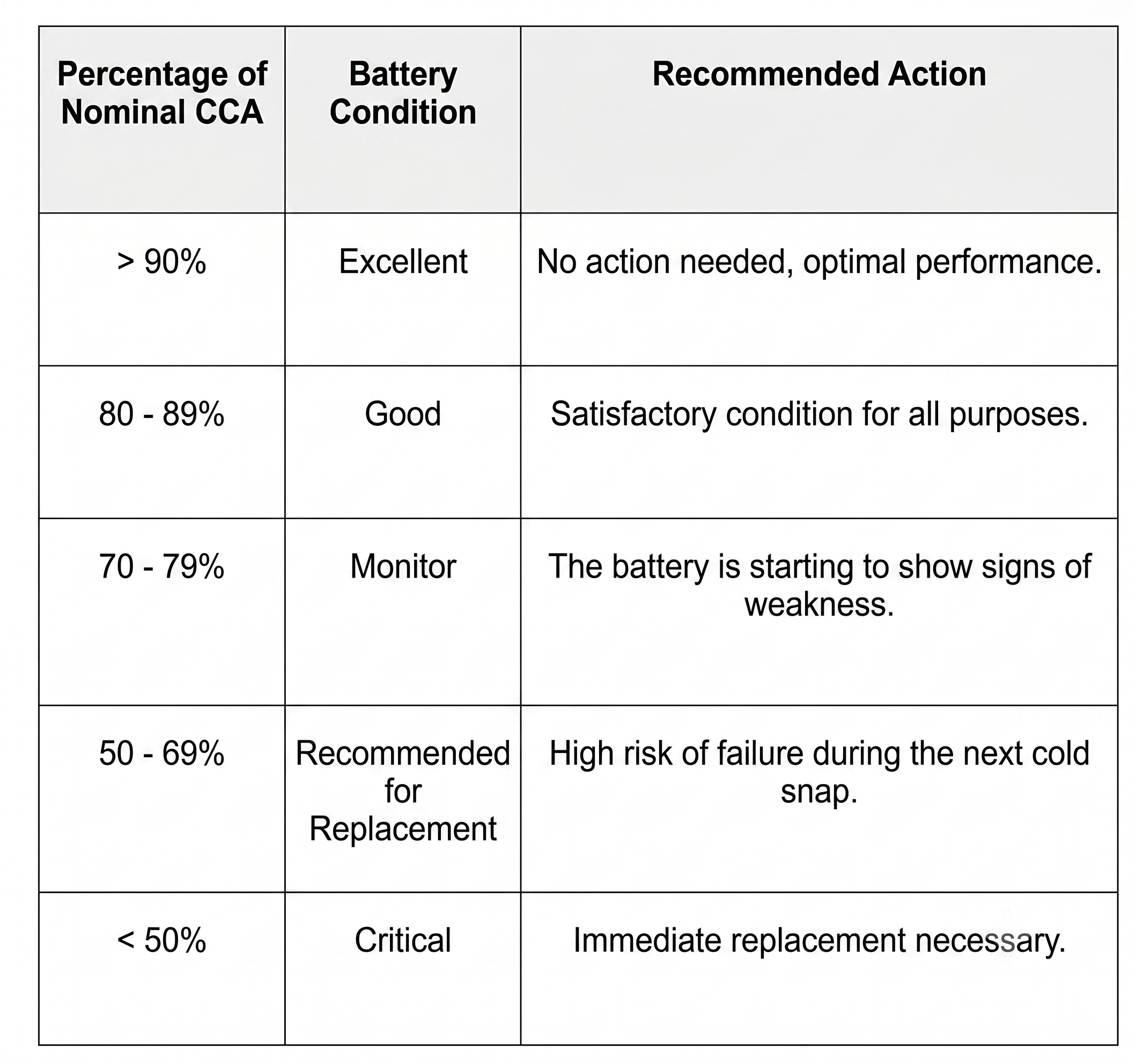
Interpreting the result of a battery test makes it possible to anticipate a failure before the vehicle even refuses to start. The interpretation thresholds recognized by these standards are as follows:
A battery reaching or exceeding 90% of its nominal CCA is in excellent condition, at full nominal capacity.
- Between 80 and 89%, the condition is good and acceptable; monitoring is simply recommended.
- Between 70 and 79%, this is a warning: an in-depth load test is required.
- Between 50 and 69%, the battery is weak and replacement is recommended.
- Below 50%, the condition is critical and replacement becomes urgent.
The following tables helps evaluate the health status of your power source:
Why Does CCA Decrease Over Time?
A battery is a living chemical component. Several factors explain the degradation of its cranking capacity:
- Chemical aging: Inside lead-acid batteries, the plates sulfate over time. Lead sulfate crystals harden and reduce the chemical exchange surface area, limiting the available current.
- Charge and discharge cycles: Each charge and discharge cycle physically wears the internal components. A battery that has undergone repeated deep discharges will see its CCA drop drastically.
- Extreme temperatures: While cold reduces immediate performance, it is summer heat that accelerates internal corrosion, degrading energy storage and restitution capacity for the following winter.
CCA Monitoring with Telematics
For managers of vehicle fleets or critical equipment, battery failure is a major operational cost. This is where the technological contribution of DUNASYS becomes strategic.
The Contribution of the DUNASYS Unit
The DUNASYS telematics unit directly measures the starting current. At every engine start, it captures the current peak supplied to the battery, enabling an estimate of the actual CCA under real-world operating conditions.
Why Use Monitoring?
- Anticipation: Receive an alert as soon as the measured CCA falls below the 70% threshold.
- Optimized selection: Identify which type of battery is best suited to your actual usage.
- Protection: Avoid the emergency use of a booster, which can damage the onboard electronics of modern vehicles.
Conclusion
In summary, CCA should no longer be an abstract value but the central barometer of your maintenance strategy. Whether your vehicles are equipped with lead-acid, AGM, or new storage technologies such as LiFePO4 (Lithium), monitoring the available cold-start current is the only way to prevent failure.
An optimized cranking capacity is essential for powering demanding engines, especially for professional applications requiring 24/7 availability. Do not settle for the original nominal value: the real-world life of your battery depends on rigorous monitoring.
By integrating DUNASYS telematics solutions, you transform a technical constraint into a performance driver. Through precise and continuous measurement of your power supply output, you choose protection and anticipation over emergency booster use. Choose expertise to extend the lifespan of your equipment and guarantee consistent performance, whatever the weather.