Battery Health Monitoring: Understanding the State of Health of a 12V Battery
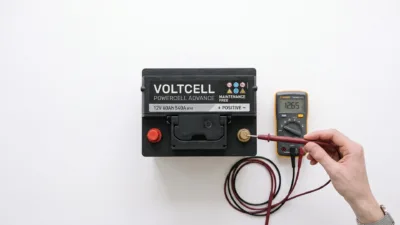
Introduction
The 12V battery remains an essential component in the electrical architecture of modern vehicles. Present in combustion, hybrid, and electric vehicles alike, it performs critical functions: powering control units, supervising systems, starting the engine, and maintaining onboard equipment.
Despite this central role, its state of health is still too often assessed in a partial manner.
In many cases, battery diagnostics rely on one-off checks carried out in the workshop. These tests make it possible to verify a condition at a given moment, but they only provide a limited view of the battery’s actual behavior over time.
Yet a battery does not degrade suddenly. It evolves progressively, under the effect of its usage, environmental conditions, and the electrical stresses it is subjected to.
It is in this context that Battery Health Monitoring comes in: an approach that aims to better understand the actual condition of a battery by observing its indicators over time and under real-world operating conditions.
Why Battery Health Is a Key Issue in the Automotive Industry
In today’s vehicles, the 12V battery plays a far more structural role than before. It is no longer limited to ensuring the engine starts: it contributes to the overall proper functioning of the vehicle.
A failure can lead to:
- an inability to start,
- intermittent electronic faults,
- loss of vehicle availability,
- or unplanned interventions.
In modern usage, several factors heighten these risks:
- multiplication of electronic equipment,
- frequent Start/Stop cycles,
- short trips with incomplete recharging,
- extended periods of immobilization,
- significant thermal constraints.
In this context, the battery becomes a critical reliability point, particularly in environments where vehicle availability is essential.
What Is the State of Health (SOH) of a 12V Battery?
The state of health of a battery, or SOH (State of Health), corresponds to its ability to deliver its performance over time, under its real-world operating conditions.
It is not simply a matter of knowing whether the battery is charged, but of determining whether it remains capable of fulfilling its function durably.
SOH and SOC: Two Distinct Concepts
- SOC (State of Charge) : the charge level at a given moment.
- SOH (State of Health) : the level of aging and the actual capacity to function over time.
A battery can therefore be correctly charged while still being degraded.
What Is Expected of a Healthy Battery
A 12V battery considered “healthy” must be able to:
- deliver stable voltage,
- provide sufficient starting capacity,
- maintain consistent behavior under different conditions,
- and remain reliable over time.
The challenge is therefore not only to check its current condition, but to understand how it is evolving.
Why Do 12V Batteries Degrade?
Battery aging is a progressive phenomenon, influenced by several factors:
- charge and discharge cycles,
- temperature,
- operating conditions,
- lifespan,
- and the technology used.
Over time, several effects appear:
- performance decline,
- reduction in usable capacity,
- increase in internal resistance,
- degradation of starting capabilities.
Often Demanding Operating Conditions
In practice, certain situations accelerate these phenomena:
- short trips with incomplete recharging,
- prolonged vehicle immobilization,
- frequent cold starts,
- intensive use of electrical equipment,
extreme weather conditions.
These effects are not always visible during a one-off test, but they become perceptible when the battery is observed over time.
To go further:
Key Battery Health Indicators
Assessing battery health relies on several complementary indicators. Taken in isolation, they provide partial information. Tracked over time, they make it possible to better understand how the battery is evolving.
This page presents the key concepts. Each indicator is detailed in a dedicated article.
Resting Voltage (OCV)
The battery resting voltage, or OCV, provides a first indication of the state of charge and certain battery behaviors.
It must be interpreted with caution, as it is strongly dependent on measurement conditions. Tracked over time, it can nevertheless reveal drifts.
See the dedicated article:
12V Battery Resting Voltage (OCV)
Cold Cranking Amps (CCA)
CCA reflects the battery’s ability to deliver a high current during starting.
It is an indicator directly linked to real-world vehicle usage and the battery’s ability to fulfill its primary function.
See the dedicated article:
CCA Battery: Starting Capacity
Internal Resistance
Internal resistance increases with battery aging. It directly impacts the battery’s ability to deliver energy rapidly.
It is a particularly useful indicator for detecting early-stage degradation.
See the dedicated article:
Battery Internal Resistance
Consistency of Measurements Over Time
Beyond the values themselves, the stability of measurements is an important indicator.
Unusual variations can reveal abnormal behavior or the onset of degradation.
Why One-Off Battery Tests Have Their Limits
Tests carried out in the workshop make it possible to assess a battery at a given moment. They remain useful, but have limitations.
They do not make it possible to:
- track evolution over time,
- observe real-world operating conditions,
- or detect weak signals of degradation.
A one-off result can be correct while masking a progressive drift.
What enables failure anticipation is not just a value, but a trend.
From One-Off Testing to Continuous Monitoring
Battery Health Monitoring relies on a different approach: observing the battery under its real-world operating conditions, over time.
This makes it possible to:
- track operating cycles,
- analyze behavior under real-world conditions,
- identify drifts,
- and better understand the aging trajectory.
This approach is particularly relevant in contexts where vehicle availability is critical.
To go further:
Predictive Battery Maintenance
From Battery Diagnostics to Onboard Monitoring: A More Actionable Approach
In an onboard monitoring approach, the battery is no longer simply tested periodically. It is observed continuously, in its real environment.
This makes it possible to better interpret the indicators and place each measurement in its usage context.
Observation Under Real-World Conditions
The battery can be monitored in the most representative situations:
- rest phases,
- starts,
- variable weather conditions,
- repeated usage cycles.
This reading provides a more detailed understanding than that obtained through an isolated test.
The Role of the Dunasys Telematics Unit
The Dunasys telematics unit makes it possible to collect and exploit data directly from the vehicle.
This approach enables:
- tracking indicators over time,
- observing changes between cycles,
- detecting progressive drifts,
- and transforming technical data into actionable maintenance information.
A Response to Operational Challenges
For mobility and automotive stakeholders, the challenge is to:
- anticipate failures,
- limit immobilizations,
- plan interventions,
- and improve the overall reliability of vehicles.
Continuous monitoring makes it possible to shift from a reactive mindset to an anticipatory one.
Toward Smarter 12V Battery Maintenance
The evolution of battery diagnostics is part of a broader transformation of maintenance practices.
The progression is gradual:
- from one-off testing,
- to continuous observation,
- then to a predictive maintenance approach.
Battery health thus becomes an actionable indicator for improving vehicle availability and performance.